The Land Use Act of 1978 means you hold a government license, not a title. And the 1999 Constitution makes it almost impossible to change.
There is a question that sounds simple until you try to answer it precisely: do Nigerians own land? The answer is no. Not in any meaningful sense. And this is not a legal technicality buried in dusty statutes. It is the operating reality of property in Nigeria, and it has profound consequences for every person, family, and farmer in the country. The mechanism is the Land Use Act 1978.
What the Land Use Act actually says
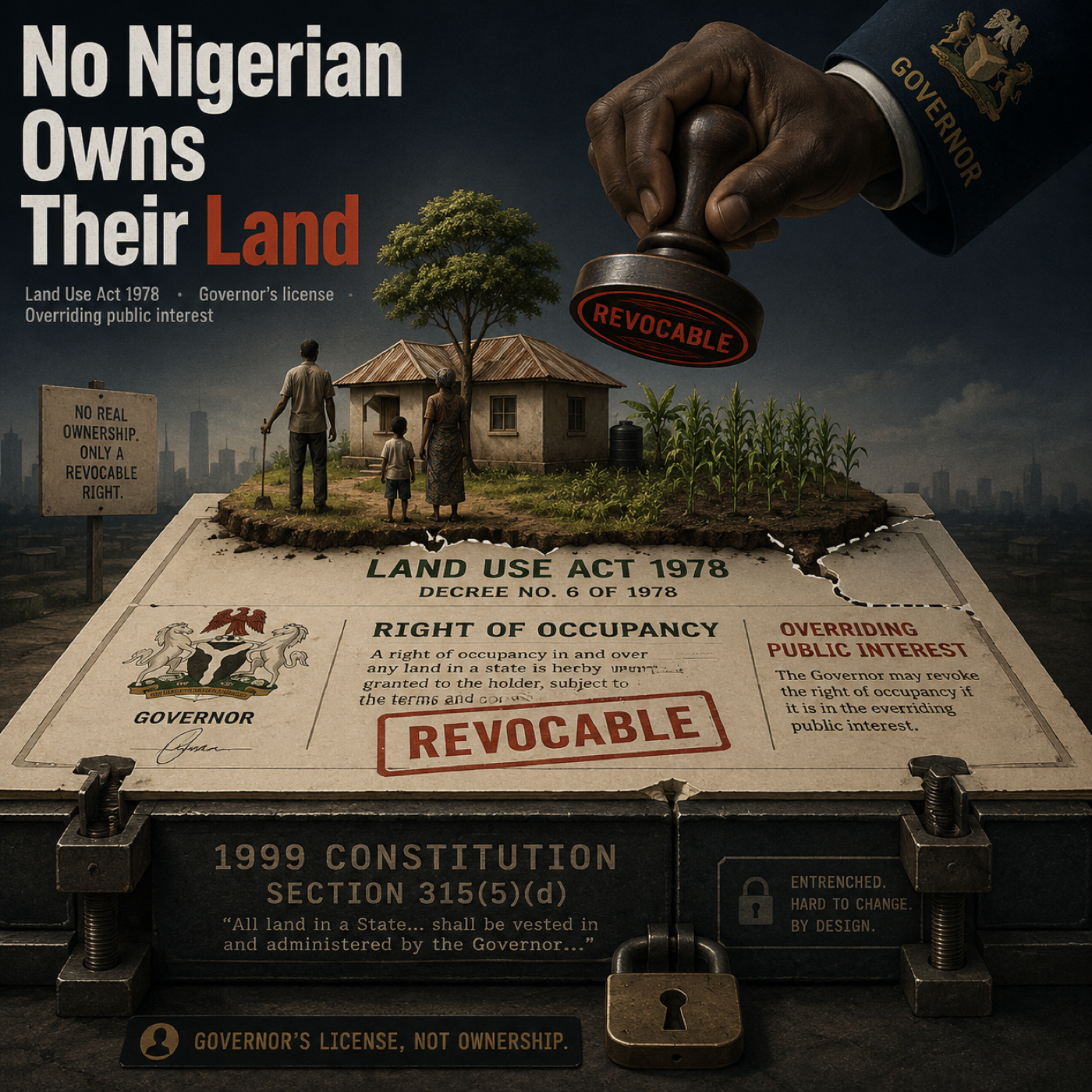
The Act vests all land in each state in the Governor of that state. Every piece of land in Nigeria, urban and rural, commercial and residential, belongs, in law, to the governor. What a Nigerian “owner” holds is a Statutory Right of Occupancy: a revocable license granted by the governor to use and occupy the land.
Section 5(1) of the Act reads: “It shall be lawful for the Governor… to grant statutory rights of occupancy to any person for all purposes.” Section 28 reads: “It shall be lawful for the Governor to revoke a right of occupancy for overriding public interest.” The definitions of “overriding public interest” include the requirement of land for public purposes, for mining or oil exploration, or for any purpose the Governor considers to be for the good of the state. In summary? You do not own your land. You hold a government-issued permit to use it. The government can take it back.
Why this matters for ordinary Nigerians
First: collateral. Banks in Nigeria routinely refuse to issue mortgage loans or agricultural credit without a Certificate of Occupancy (C of O). The C of O is the formal documentation of your statutory right of occupancy. Getting one requires navigating a bureaucratic process that takes years in most states, costs significant money in fees and unofficial payments, and is subject to administrative discretion at every stage. Millions of Nigerians who occupy land, including land their families have held for generations, have no C of O and therefore cannot use that land as collateral for any formal credit.
This is one structural reason why Nigerian agriculture remains dominated by subsistence farmers rather than capitalised agricultural enterprises. A farmer who cannot mortgage land cannot borrow to buy inputs, expand, or mechanise. The Land Use Act traps agricultural productivity at the level of what a farmer can finance personally.
Second: community displacement. Section 28’s “overriding public interest” provision has been used to displace communities in favour of government infrastructure projects, oil company operations, and well-connected real estate developers. When displacement happens, compensation is calculated on the value of the unexhausted improvements on the land (buildings, planted trees), not on market land value, because in law the land itself belongs to the state and therefore has no compensable value. A community that has occupied land for three generations can be dispossessed for a compensation figure that bears no relationship to what the land is actually worth.
This happened in the Niger Delta. This happened in Lagos’s expanding commercial districts. This is still happening across Nigeria wherever infrastructure and private development intersect with existing occupation.
Third: urban land speculation. Because C of Os are bureaucratically difficult and expensive to obtain, much of Nigeria’s urban land changes hands in informal markets where legal title is unclear, multiple claims exist on the same parcel, and disputes can only be resolved in courts that are slow and expensive. The Land Use Act did not eliminate private land markets, it pushed them underground and made them legally precarious.
Where it came from
The Land Use Act was Decree №6 of 1978, issued by the Supreme Military Council under General Olusegun Obasanjo. It was not debated by elected representatives. It was not subject to public consultation. It was not reviewed by any parliamentary body. It was handed down as a decree by a military government.
The original stated rationale had two parts. First, to facilitate land acquisition by the government for development projects by removing the complications of private freehold ownership. Second, to nationalise the benefits of land, particularly in the context of the oil boom, rather than allowing them to accrue solely to private landowners in oil-producing communities.
In practice, it achieved neither goal effectively and created significant new problems. Land acquisition by government did become administratively easier, but this also made it easier to displace communities without adequate compensation. The benefits of land did not flow to ordinary Nigerians, they flowed to governors, politically connected developers, and those with the resources to navigate the C of O system.
The constitutional trap
This is where the 1999 Constitution enters. Section 315(5)(d) of the Constitution lists the Land Use Act among a set of “existing laws” that are given constitutional status. This means the Act can only be amended or repealed by the same process required to amend the Constitution itself: under Section 9, a bill supported by not fewer than two-thirds of all members of each House of the National Assembly, ratified by resolutions of the Houses of Assembly of not fewer than two-thirds of all states (at minimum 24 of 36 state Houses of Assembly).
Table: What it takes to amend or repeal the Land Use Act
| Step | Threshold |
|---|---|
| National Assembly | A bill supported by not fewer than two-thirds of all members of each House |
| State Houses of Assembly | Resolutions of not fewer than two-thirds of the 36 Houses, at minimum 24 |
| Basis | Constitution of 1999, section 9, applied through section 315(5)(d) |
This was a deliberate choice. The 1979 Constitution, drafted under Obasanjo’s military government and carried over almost entirely into the 1999 Constitution, entrenched the Land Use Act to make it politically difficult to remove. Oil companies benefited from the act’s provision that oil exploration required only a governor’s revocation, not direct acquisition from private owners. State governments benefited from controlling all land within their territory. Large commercial interests benefited from a system in which access to land depended on bureaucratic relationships with state governments rather than market transactions.
The people who benefited from the Land Use Act were the people who would need to vote to remove it. They have not.
What the reform would require
To repeal or substantially amend the Land Use Act requires: Two-thirds of the 469-member House of Representatives (313 members). Two-thirds of the 109-member Senate (73 senators). Resolutions from at least 24 of 36 State Houses of Assembly.
Every governor in Nigeria has an interest in maintaining control over land in their state. Every sitting government benefits from the power to revoke rights of occupancy for “overriding public interest.” The reform coalition has never assembled because the political economy runs entirely against it. This is precisely what the constitution’s entrenchment was designed to ensure.
The practical status in 2026
As of 2026, the Land Use Act is still in force. C of O processes are still slow, expensive, and bureaucratic in most states. Agricultural credit backed by land remains largely inaccessible to smallholder farmers. Community displacement for development projects continues. Multiple attempts at Land Use Act reform, including recommendations by the 2005 National Political Reform Conference and the 2014 National Conference, have produced nothing.
The 2014 National Conference recommended removing the Land Use Act from the list of entrenched statutes in Section 315 and reverting land tenure to a reformed framework that would recognise community land rights and private freehold ownership. That recommendation, like most of the 600 recommendations produced by that conference, was shelved.
The honest summary
You do not own your land in Nigeria. You hold a governor’s license. That license can be revoked for “overriding public interest”, a standard that has been interpreted broadly enough to cover nearly any government or commercial priority. The compensation you receive when it is revoked is calculated on your improvements, not on the land’s market value. Even worse? The value of compensation and how said compensation is paid (in installments, by exchange of another land etc), is decided by the same government who can revoke the license. It stands to reason that such land may never be valued fairly or correctly.
The law that created this situation was issued by a military government in 1978. It was entrenched in the constitution specifically to make it difficult for future democratic governments to undo. The people who benefit from keeping it are the people who would need to vote to change it.
This is not an accident. It is the system working as designed.
Primary sources: Land Use Act (Cap L5, LFN 2004); CFRN 1999 ss.44, 315(5)(d); Nkwocha v. Governor of Anambra State (1984) 1 SCNLR 634 — constitutionality of Land Use Act affirmed; Report of the 2014 National Conference, Chapter 6 (Land Tenure Reform); nigerialaw.extrafemi.com Federal Acts database.
This is part of a series on structural flaws in the 1999 Constitution. The first piece examined the security provision: s.14(2)(b) says security is government’s “primary purpose”; s.6(6)(c) makes it unenforceable in any court.