It is not really the job of the government of Nigeria to ensure/ provide security for Nigerians.
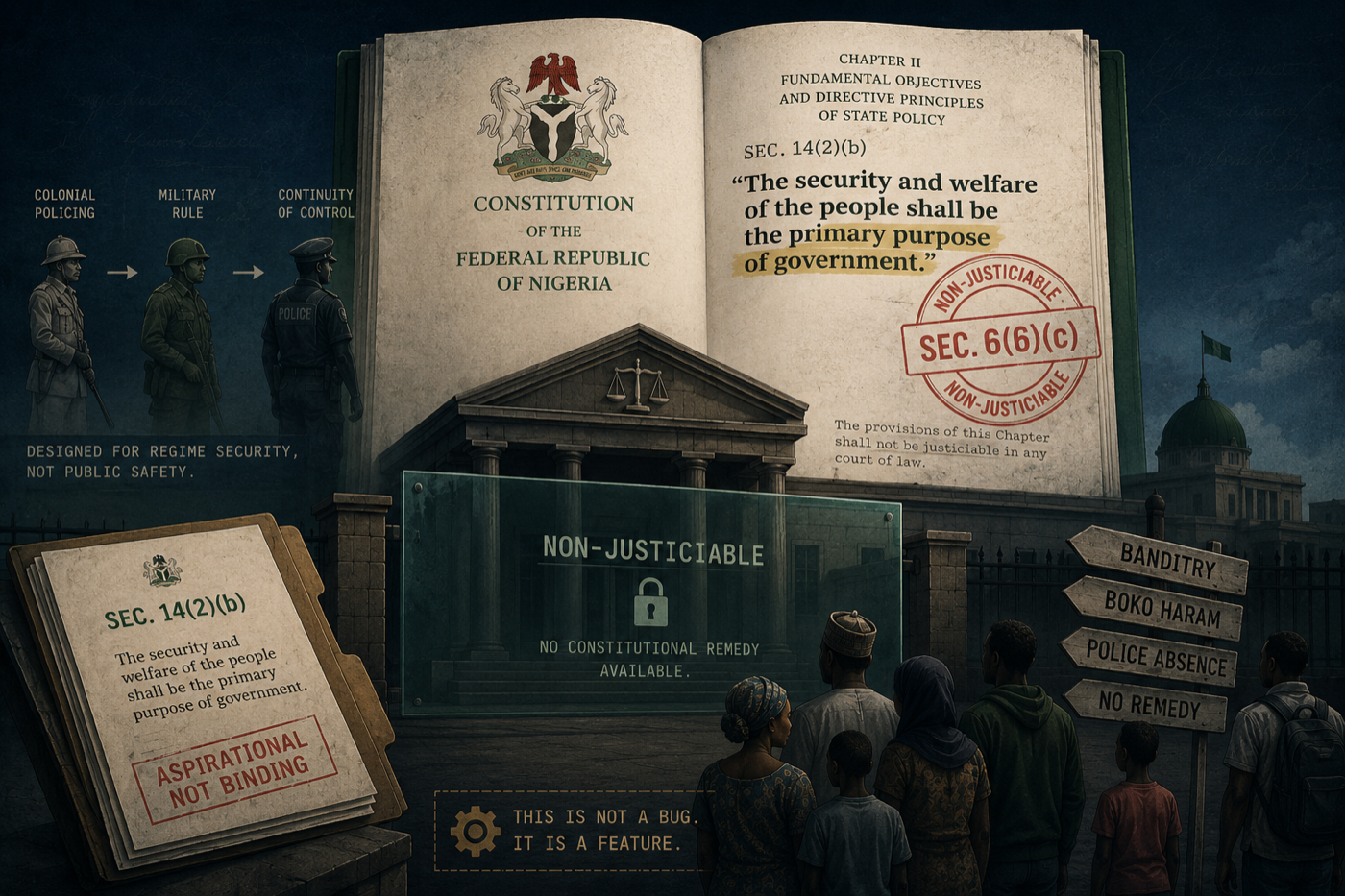
This is one of the most important and misunderstood questions in Nigerian constitutional law. The honest answer is complicated. The constitution does impose a security obligation on the state but it is deliberately unenforceable.
Section 14(2)(b) of the 1999 Constitution states:
“The security and welfare of the people shall be the primary purpose of government”
That sounds definitive. But Section 6(6)(c) immediately neutralises it. It excludes Chapter II which contains Section 14 from the jurisdiction of any court. This means a Nigerian cannot sue the government for failing to provide security under Section 14. It is a directive principle, not a justiciable right. This was a deliberate architectural choice inherited from the Indian Constitution’s non-justiciable Directive Principles of State Policy. The drafters of the 1979 Constitution (which the 1999 Constitution largely copied) wanted aspirational language without legal accountability. Justice Udo Udoma’s Constituent Assembly knew exactly what they were doing.
What IS enforceable is narrower:
Section 33 (right to life) and Section 35 (personal liberty) in Chapter IV are justiciable. But these create negative obligations i.e the state must not kill or detain you arbitrarily. They do not create a positive duty to protect you from others.
The Police Act (now the Police Act 2020) establishes the NPF and gives it a protection mandate but it is statutory, not constitutional, and Parliament can amend it. The Act itself says the police shall “protect the lives and property of all persons in Nigeria” but Nigerian courts have consistently held that this creates no individual cause of action. You cannot sue the police for failing to prevent a crime against you. This was confirmed in cases like Inspector-General of Police v. All Nigeria Peoples Party (2007).
Where did this architecture come from?
1. British colonial design. The colonial security apparatus was designed to protect the colonial state and its economic interests: tin, groundnut, palm oil not the population. The Nigerian Police Force was created by the Police Ordinance 1930 to suppress civil unrest, not provide public safety. That orientation was never structurally reversed at independence.
2. Military-era governance norms. Between 1966 and 1999, Nigeria spent 29 of 33 years under military rule. Security was the instrument of regime survival, not a public service. When the 1979 and 1999 constitutions were drafted, they were drafted by or under the supervision of military governments with no interest in creating enforceable security rights that could be used against the state.
Nigeria spent 29 of the 33 years from 1966 to 1999 under military rule
Hover, focus or click a bar for its detail. Click to pin it and compare the others against it.
3. The 1979 Constituent Assembly’s deliberate choice. The non-justiciability of Chapter II was debated and chosen. The argument made, similar to Nehru’s India, was that Nigeria was too poor to have courts enforce socioeconomic and security obligations. The practical effect was that the government got the legitimising language (“security is our primary purpose”) without the legal liability.
The honest summary
The Nigerian state has a constitutional aspiration to provide security, a statutory mandate through the Police Act, and zero enforceable legal obligation to any individual.A citizen whose community is destroyed by bandits, whose village is attacked by Boko Haram, whose neighbourhood is abandoned by police has no constitutional remedy. The state can acknowledge the failure, set up a commission of inquiry, and carry on.
This is not an accident. It is the system working as designed.
The gap between Section 14(2)(b) (“security is our primary purpose”) and Section 6(6)(c) (“but no court can enforce this”) is arguably the single most consequential structural flaw in the 1999 Constitution and the one least discussed in mainstream Nigerian legal and political discourse.